Model verbs and their distributions
Why does every verb feel irregular?
Russian verbs are easy — just learn how to conjugate these ~60 verbs.
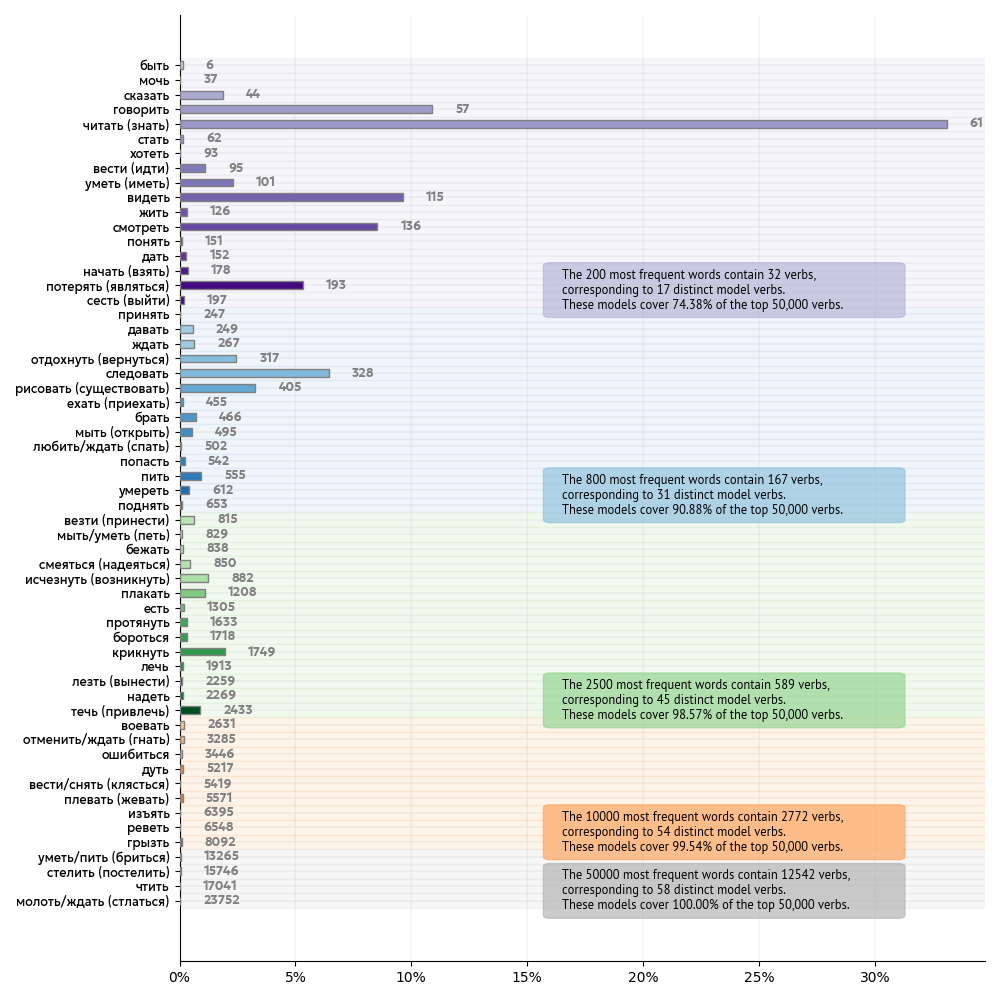
Note: There is a typo in the graphic. Where it says "the top 50,000 verbs", it should say "the ~12,000 verbs that have a ranking in the Russian National Corpus 52k-word frequency ranking"
Each bar represents a conjugation model, labeled by a representative "model verb" in the infinitive. Where a verb appears as "Verb A (Verb B)", Verb B is actually more frequent, but was not chosen as the model — typically because it is reflexive, monosyllabic, or otherwise atypical of the group.
The models were defined by starting with the traditional classification in Russian grammar (5 productive classes and ~16 non-productive groups), then subdividing by stress pattern — so писа́ть and пла́кать, though superficially similar, are treated as distinct models.
The horizontal axis shows what percentage of the ~12,000 verbs in the Russian National Corpus' frequency ranking conjugate like that model. The number to the right of each bar is the frequency rank of the most common verb in that group — a rough proxy for how early a learner is likely to encounter it.
The picture that emerges explains a common frustration. быть ranks #6 overall, but almost no other verbs conjugate like it. The 200 most frequent words contain 32 verbs, spread across 17 distinct models — and only 5 of those models account for more than 5% of all verbs. Almost every new verb a beginner encounters seems to follow its own rules.
But unlike in Spanish, these verbs are not actually irregular. The patterns are real — they're just unevenly distributed. By the time you reach the top 800 words, you've encountered 167 verbs across 31 models, and those 31 models together cover over 90% of all verbs in the corpus. The chaos is front-loaded.
| Frequency cutoff | Verbs encountered | Distinct models | Coverage |
|---|---|---|---|
| Top 200 words | 32 | 17 | 74.38% |
| Top 800 words | 167 | 31 | 90.88% |
| Top 2,500 words | 589 | 45 | 98.57% |
| Top 10,000 words | 2,772 | 54 | 99.54% |
| All ranked verbs | 12,542 | 58 | 100% |
The highest-coverage models
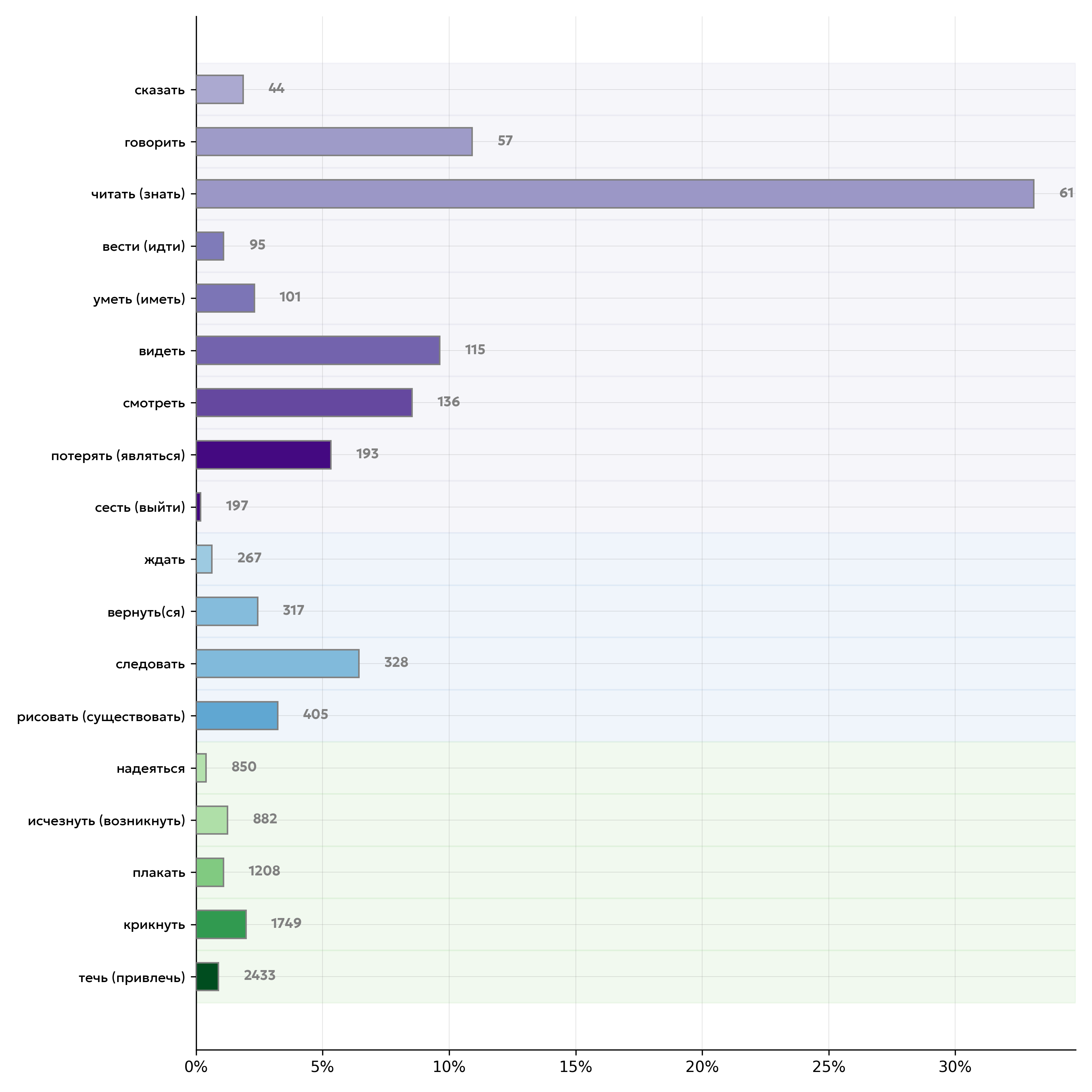
The chart above shows only the models with 10 or more verb families. The table below covers the remainder — models that are real and regular, but rare enough that the verbs following them feel like one-offs.
| Model verb | Highest rank | Families |
|---|---|---|
| быть | 6 | быть, забыть, добыть |
| мочь | 37 | мочь, помочь, -немочь- |
| стать | 62 | стать, устать, деть, -стрять, |
| хотеть | 93 | хотеть |
| жить | 126 | жить, плыть, слыть |
| понять | 151 | понять, занять, нанять, унять |
| дать | 152 | дать, создать, продать |
| начать | 178 | начать, взять, жать, мять |
| принять | 247 | принять |
| давать | 249 | давать, ставать, создавать, знавать, продавать, сознавать, уставать |
| ехать (приехать) | 455 | ехать |
| брать | 466 | брать, звать, орать, драть, сосать, |
| мыть (открыть) | 495 | крыть, скрыть, мыть, выть, ныть, рыть |
| спать | 502 | спать |
| попасть | 542 | пасть, класть, красть, прясть |
| пить | 555 | пить, бить, лить, шить, вить, гнить, |
| умереть | 612 | мереть, переть, тереть, стереть, простереть |
| поднять | 653 | поднять, снять, обнять, отнять, |
| принести | 815 | нести, везти, пасти, трясти, ползти |
| петь | 829 | петь |
| бежать | 838 | бежать |
| смеяться | 1054 | смеять |
| есть | 1305 | есть, надоесть |
| протянуть | 1633 | тянуть, глянуть, помянуть, , тонуть, минуть |
| бороться | 1718 | бороть, колоть, полоть, молоть, пороть |
| лечь | 1913 | лечь, жечь, сечь, течь, стричь, печь |
| вынести | 2259 | нести, лезть, лезти, везти, ползти, трясти |
| основать | 2390 | основать, жевать, совать, ковать, сновать |
| воевать | 2631 | воевать, горевать, плевать, малевать, дневать, клевать |
| гнать | 3285 | гнать |
| ошибиться | 3446 | -шибить- |
| дуть | 5217 | дуть, -уть- |
| клясть (клясться) | 5419 | клясть |
| плевать | 5735 | плевать, клевать, блевать, ковать |
| изъять | 6395 | изъять |
| реветь | 6548 | реветь |
| грызть | 8092 | грызть |
| брить (бриться) | 13265 | брить |
| стелить (постелить) | 15746 | стелить |
| чтить | 17041 | чтить |
| стлать (стлаться) | 23752 | стлать |
Verbs that could actually be considered irregular
Traditional Russian grammar claims only a handful of truly irregular verbs, but arriving at that conclusion requires some careful distinctions. Three categories are worth separating out.
Actually irregular: дать, есть, хотеть, and their prefixed derivatives (including продать, создать, надоесть, which are etymologically independent). Also стелить, бежать, and чтить — these have "mixed conjugation," behaving partly like a Conjugation I verb and partly like Conjugation II.
Unique but regular: These verbs follow consistent internal logic, but their combination of nonpast and past stems doesn't match any other group. быть and derivatives (бу́д- / бы́-), ехать (е́д- / е́х-), реветь (рев- / реве́-), and -шибить- (as in ошибиться; -шиб- / -ши́б-).
Split-personality verbs: These conjugate like one model in the nonpast tense and a completely different model in the past tense. спать (любить in nonpast / ждать in past), петь (мыть / уметь), гнать (отменить / ждать), клясть (вернуться / снять), брить (уметь / пить), стлать (молоть / ждать).